Short answer: yes, emotions are connected to the mind, but they are not created by the mind alone.
If you’ve ever tried to “think your way out” of a feeling and failed, you already know this intuitively.
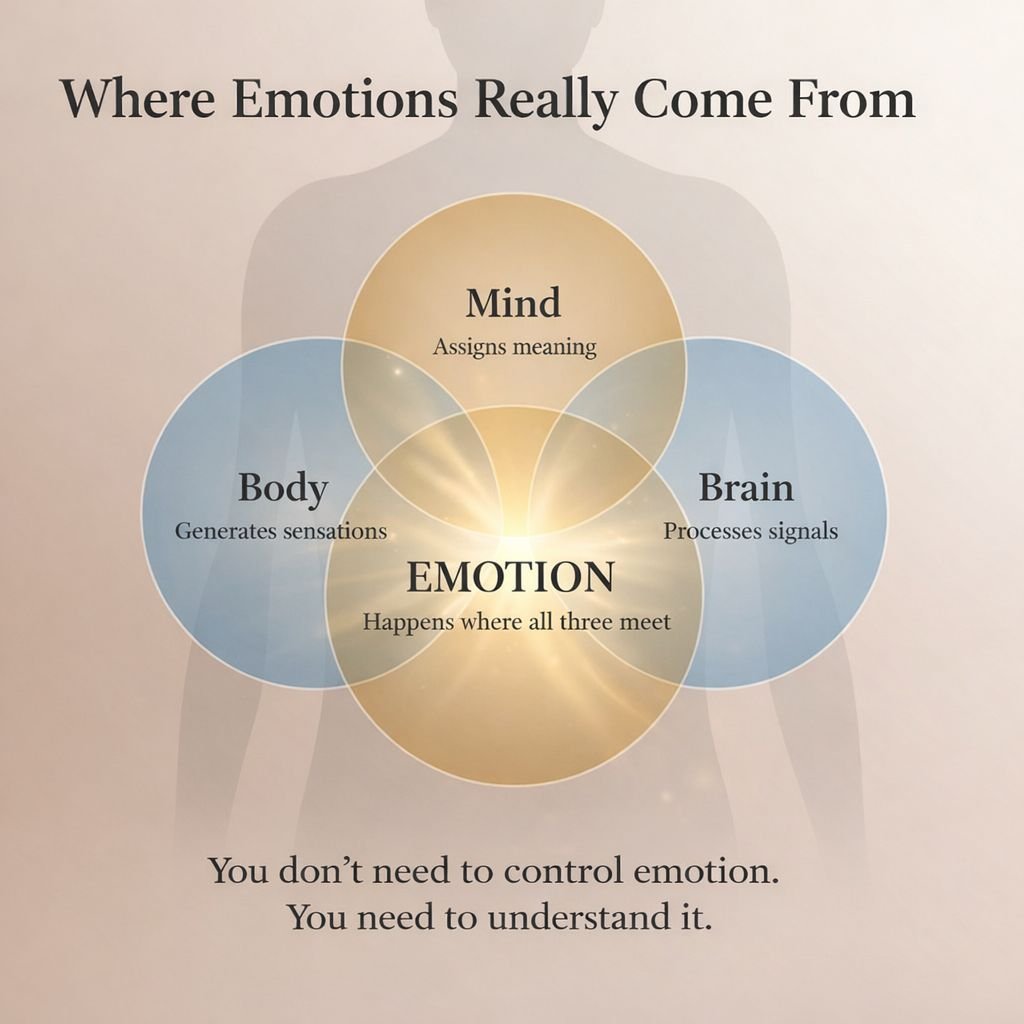
Emotions live at the crossroads of body, brain, and mind.
Your body generates sensations.
Your brain processes signals.
Your mind assigns meaning.
Emotion happens where all three meet.
Understanding this relationship is powerful because it shows you something most people never learn:
You may not control the first emotional wave, but you do influence what happens next.
And that is where healing lives.
How Emotions Actually Work (In Plain English)
Let’s simplify the process:
- Your body senses something (stress, connection, threat, safety).
- Your brain interprets those signals.
- Your mind tells a story about what it means.
- You experience emotion.
- Your thoughts react.
- Your body responds again.
It’s a loop.
Not a straight line.
Think of it like this:
- Your body plays the music.
- Your mind writes the lyrics.
- Emotion is the song.
Same physical sensation. Different story. Completely different emotion.
A racing heart could mean fear, excitement, love, or anticipation.
The body provides the sensation.
The mind decides the meaning.
That meaning shapes your emotional experience.
Why Trying to “Control” Your Emotions Rarely Works
Most of us were taught to suppress feelings, distract ourselves, or power through discomfort.
That approach usually backfires.
Here’s why:
You cannot stop an emotion from rising.
It is a biological response.
But you can stop building a mental mansion on top of it.
Most suffering does not come from emotion itself.
It comes from the story we attach to the emotion.
Pain is natural. Resistance is optional.
Emotion is weather.
Your thoughts decide whether you grab an umbrella or declare war on the sky.
This idea is beautifully supported in modern trauma research, including insights popularized in books like The Body Keeps the Score, which explains how unprocessed emotions are stored in the body, not just remembered in the mind.
The Difference Between Feeling and Identity
This part changes everything.
There is a massive difference between:
“I feel anxious.”
and
“I am anxious.”
One is an experience.
The other is an identity.
Feelings are temporary visitors.
Thoughts are roommates.
You are the landlord.
When you identify with every emotion, you give it permanent residency.
When you observe emotions instead, they pass through like weather.
Practical Action Steps You Can Start Using Today
Let’s move from theory to execution.
Here are simple, grounded tools you can apply immediately.
1. Name the Sensation Before the Story
Next time emotion hits, pause and ask:
- Where do I feel this in my body?
- Is it tight, heavy, warm, buzzing?
Do this before explaining it.
This interrupts automatic mental spirals.
You’re teaching your nervous system that it’s safe to feel without overthinking.
2. Separate Sensation From Meaning
Try this sentence:
“I notice tightness in my chest… and my mind is telling me a story about it.”
That tiny pause between sensation and interpretation creates space.
Space equals choice.
3. Breathe Low and Slow
Emotion lives in the nervous system.
Breathing directly influences it.
Do this for 60 seconds:
- Inhale through your nose for 4 seconds
- Exhale through your mouth for 6-8 seconds
Longer exhales tell your body: we’re safe.
You cannot think your way into calm.
You breathe your way there.
4. Ask the Upgrade Question
Instead of:
“Why am I like this?”
Ask:
“What is this emotion asking me to notice or change?”
Emotions are messengers.
Treat them like data, not enemies.
5. Practice Emotional Completion
Most emotions want movement.
Walk. Stretch. Shake your arms. Get outside.
Let the energy move through you instead of storing it in your shoulders or stomach.
Unfelt emotion becomes stored tension.
Felt emotion becomes wisdom.
The Big Takeaway
Emotions are not just in your mind.
They are embodied experiences shaped by your thoughts.
You don’t heal by suppressing feelings.
You heal by allowing sensation, questioning stories, and choosing responses.
You don’t become powerful by eliminating emotion.
You become powerful by learning how to be present with it.
Feelings are visitors.
Thoughts are roommates.
You are still the landlord.
Act like it.