Have you ever defended a decision, belief, or direction in life so strongly that changing your mind almost felt like admitting defeat?
Maybe it was a career you spent years pursuing. A relationship you believed would last forever. A dream you were convinced would define your future.
And then something changed.
Perhaps you learned something new. Maybe life presented circumstances you never anticipated. Or perhaps you simply became someone who no longer sees the world the same way.
Yet instead of embracing that change, you found yourself struggling with one uncomfortable thought:
What does it say about me if I no longer believe what I once believed so strongly?
Here’s something worth remembering: You are allowed to grow beyond your own expectations.
When the Life You Planned No Longer Fits
For a long time, I thought I knew exactly what I wanted to do with my life.
I pursued audio engineering, a field I was passionate about, and worked toward building a career doing something I genuinely loved.
At the time, I believed I had found my dream job.
Then a serious car accident changed the direction of my life.
Suddenly, the future I had envisioned was no longer the future I could continue pursuing in the same way.
It wasn’t a transition I had planned. It wasn’t some carefully calculated career move. Life had interrupted my plans, and I had to figure out what came next.
Looking back, that experience taught me something I couldn’t fully appreciate at the time.
Sometimes the life we planned has to change before we discover what else we’re capable of becoming.
My accident forced me to move away from audio engineering, but the journey that followed eventually led me toward entrepreneurship, internet marketing, and other opportunities that expanded my life in ways I hadn’t originally imagined.
Something that initially felt like losing my direction became part of discovering new ones.
I don’t believe we need to romanticize hardship or pretend that every difficult experience happens for some grand reason.
Some experiences are simply painful, disruptive, and unfair.
But even when we don’t get to choose what happens, we often have a say in how we respond and what we build afterward.
And sometimes that means letting go of the future we were once certain about.
Why Changing Your Mind Can Feel Like Failure
Human beings naturally become attached to their decisions.
The longer we’ve believed something, defended it, or invested ourselves in it, the harder it can become to reconsider.
We begin confusing consistency with integrity.
We tell ourselves that changing direction means the original decision must have been wrong.
But that’s not necessarily true.
A decision can make perfect sense for one chapter of your life and no longer serve you in the next.
Think about it.
Would you expect yourself to have exactly the same understanding of relationships, success, happiness, or personal responsibility that you had twenty years ago?
Probably not.
So why do we sometimes feel obligated to remain loyal to beliefs that were formed by a version of ourselves with less experience?
Being consistent with your past should never require being dishonest with your present.
Growth and Inconsistency Are Not the Same Thing
There’s an important distinction between changing your mind because you’ve gained a deeper understanding and changing your principles whenever they’re inconvenient.
Growth doesn’t mean abandoning your values.
In fact, it can mean becoming more committed to them.
For example, you may have once believed that success meant achieving a particular title, earning a certain income, or reaching a milestone by a specific age.
Years later, you might discover that freedom, meaningful relationships, peace of mind, or personal fulfillment matter more to you.
Does that make your earlier ambition meaningless?
Of course not.
It simply means your understanding of success has evolved.
The same applies to relationships, careers, friendships, and even the way we view ourselves.
Sometimes the most honest thing we can say is:
I see things differently now.
That doesn’t erase who we were. It acknowledges who we’ve become.
You Don’t Have to Keep Defending an Outdated Version of Yourself
One of the less obvious obstacles to personal growth is worrying about how other people will react.
People become accustomed to who we are.
They remember our opinions, our ambitions, our choices, and the things we once said we’d never do.
When we change, some people may question it.
They might remind us of what we used to believe or point out how differently we’re behaving.
And sometimes they’re right.
We are different.
But being different isn’t automatically a problem.
Imagine refusing to update your understanding of the world simply because someone might notice that you’ve changed your mind.
That would mean giving yesterday’s version of yourself authority over every decision you make tomorrow.
There’s nothing admirable about remaining stuck just to appear consistent.
You can acknowledge your past without allowing it to dictate your future.
How to Know When It’s Time to Reconsider
Of course, not every uncomfortable situation requires a dramatic change.
Sometimes growth means persevering. Other times, it means recognizing that something no longer aligns with your values, priorities, or circumstances.
The challenge is learning to distinguish between the two.
Here are three questions worth asking yourself:
1. Am I holding on because I still believe in this, or because I’ve already invested so much in it?
Time and effort matter, but they shouldn’t become the only reasons we continue down a particular path.
2. If I were making this decision today, knowing everything I now know, would I choose the same thing?
This question encourages us to evaluate our current reality instead of automatically defending yesterday’s choices.
3. Am I afraid of making a change, or am I afraid of what other people will think about that change?
Those are two very different fears, and understanding the difference can reveal what’s actually holding us back.
You don’t need to answer these questions perfectly.
The point is to become more honest with yourself.
Your Past Is Part of Your Story, Not Your Entire Identity
I don’t regret pursuing audio engineering.
It was a meaningful chapter of my life, and the passion I had for it was real.
But I’m also grateful that I eventually learned to recognize opportunities beyond the future I had originally imagined.
The person I was then couldn’t have predicted everything I’ve experienced or the directions my life would take.
And that’s okay.
I don’t expect today’s version of myself to have every answer either.
That’s part of what makes life interesting.
We learn. We reconsider. We adapt. Sometimes we discover that something we once thought was essential no longer holds the same meaning.
And occasionally, a change we resisted becomes the beginning of something we never knew we wanted.
The goal isn’t to spend your entire life proving that your younger self was right. The goal is to keep becoming someone you can respect.
So if you’ve been questioning a belief, reconsidering a direction, or recognizing that an old version of your life no longer fits, give yourself permission to explore that honestly.
You don’t have to reject your past to embrace your present.
You simply have to recognize that growth sometimes changes your perspective.
And that brings me back to a thought I believe is worth remembering:
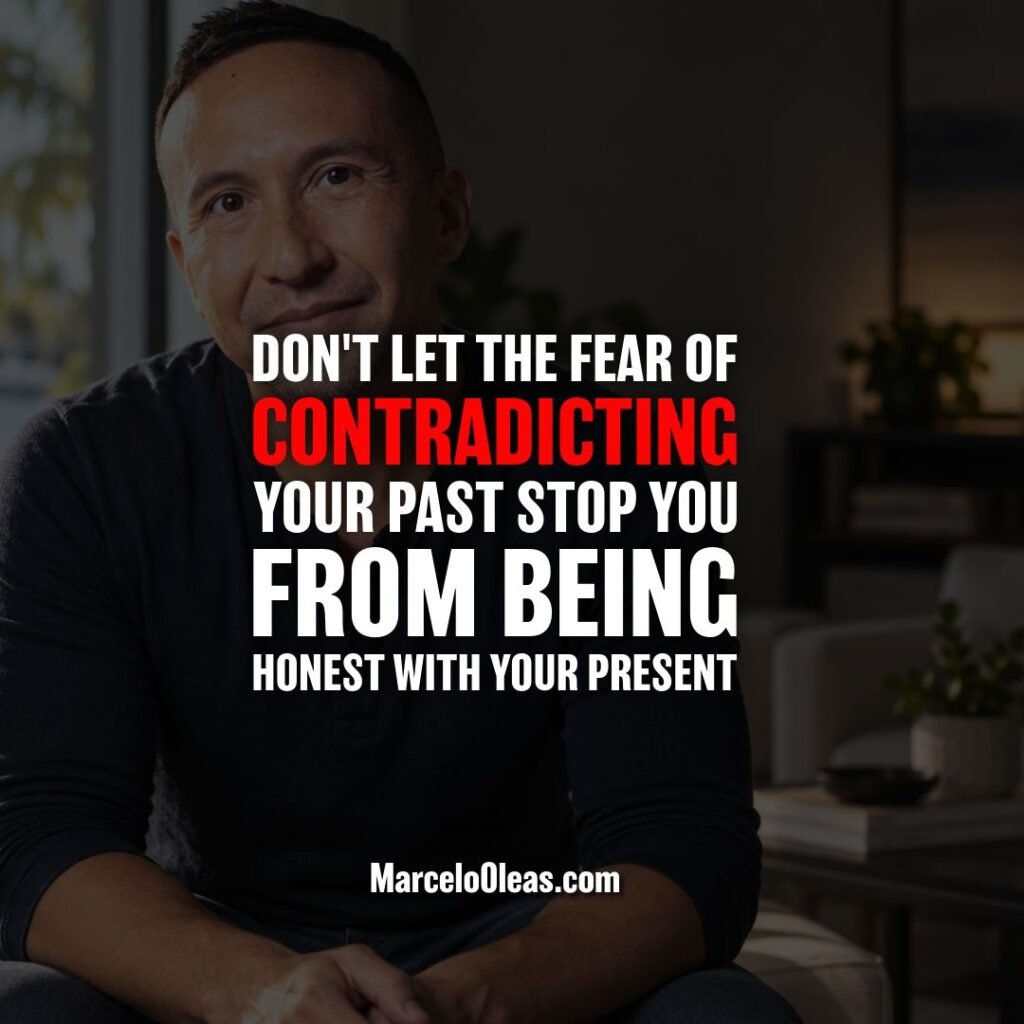
Don’t let the fear of contradicting your past stop you from being honest with your present.